Since 2012, Fractl has run dozens of content marketing campaigns designed to boost organic traffic, improve search engine rankings, and earn high‑quality backlinks. One campaign exploring global beauty standards earned nearly 1 million social media shares and appeared in almost 600 publications. Case studies like that one teach us a lot about content creation, digital marketing, and link-building strategies.
But we want data at scale — not just narratives. Over the past three years, we aggregated data from 31,000 media placements and 26,000 links earned across client campaigns. This rich dataset gave us insight into how search engine optimization (SEO), outreach, anchor text, and asset usage intersect to influence rankings.
Below are three key takeaways with tactical recommendations grounded in real metrics, SEO, and best practices.
1. Most Earned Links Receive Zero Social Shares
Don’t rely on passive promotion from your followers. You might think a link from a high‑authority site would automatically generate referral traffic and social waves. But in practice, most links get zero social shares and produce minimal visibility beyond the link metric itself.
According to other studies (e.g., Moz and BuzzSumo), three‑quarters of web pages receive no social amplification. In our data:
- 54.2% of links from sites with domain authority (DA) over 59 got zero shares
- 50.0% of links from DA over 79 got zero shares
- 51.8% of links from DA over 89 got zero shares
Despite this, each campaign still averaged ~11,000 social shares and ~110 placements. The catch: the top-performing link frequently accounts for 62.7% of total share volume. That means a few high-impact links drive most of the social and SEO lift.

Consider these SEO and outreach implications to maximize the impact of your campaign:
- Use influencers, site owners, bloggers, and journalists to seed key links early.
- Incorporate social media promotion, email blasts, and internal links (within your own web pages) to amplify visibility.
- In your link-building campaign, identify which placements are most likely to become top drivers (e.g., high‑traffic blogs and established domains) and push extra promotional firepower there.
Don’t treat link earning as passive. Instead, treat it as a combination of content and promotion.
2. Not All Links Are Equal
Anchor text, placement, and link type matter. When we say “high‑quality links,” we don’t just mean from strong domains.
The quality and SEO impact of a link depends heavily on:
- Link attribute. Is the link followed (“dofollow”) or nofollow?
- Anchor text. Does the anchor use exact match, partial match, branded, or generic text?
- Link placement. Is the link within the body copy, in footnotes, in a sidebar, or part of a byline?
- Context. Is the link used with a relevant topic, related content, or a resource page?

From our sample, many publishers provide external links that are nofollow links or use weak anchors, which diminishes their SEO value. But not all nofollow links are useless. They can help drive referral traffic or brand mentions. Still, your backlink profile should prioritize real dofollow links from topical and relevant links.
Here are some tactical steps to strengthen your link-building efforts:
- Track link types and anchor text in your outreach CRM or with tools like Ahrefs or Semrush.
- When pitching guest blogging or content contributions to website owners, specify the desired anchor text and request link placement within the body copy.
- Use broken link building and resource page outreach to gain high‑authority, contextually relevant placements.
- Monitor link-building metrics over time, such as domain authority, traffic, anchor diversity, and link velocity.
By paying attention to the anchor text diversity, link type, and placement, you shape a healthier, more valuable backlink profile that aligns with the search engine algorithm.
3. Some Publishers Won’t Use All Your Visual Assets
Adapt your visuals for the verticals you want to highlight. Rich visuals — including infographics, charts, maps, embedded video snippets — are powerful for outreach and link building. But our data shows many publishers only use a subset of what you provide.
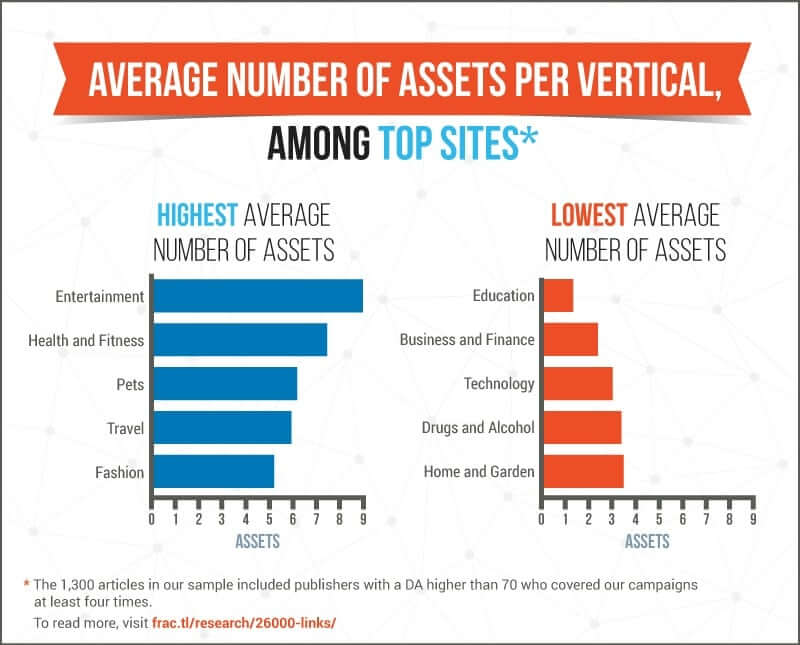
In a set of 1,300 articles with DA 70+ and at least four campaign mentions:
- Education and finance verticals tended to include the fewest visuals.
- Entertainment, lifestyle, and e-commerce verticals showed higher usage of images and video.
- Verticals with greater “asset tolerance” correlated with more frequent use of external visual elements.
Even in cases where not all assets get used, the presence of strong visuals often helps open doors for coverage on high-authority sites, guest posting leads, or bloggers who pick up your concept.
Some of the best practices for visual assets include:
- Design modular visuals so publishers can cherry-pick elements such as small charts, single images, and simplified versions of infographics.
- Tailor asset bundles by vertical: lighten the load for stricter editorial environments (e.g., medical, finance) and enrich for creative domains (media, arts).
- Wherever possible, include embed codes or ensure formats are web-friendly (jpg, png, SVG) to reduce technical friction (helping webmasters adopt them).
- Add alt text and attribution right beneath the image, and include a link-building credit line to encourage a proper link back to your site.
This way, you maximize your retention of visual value while acknowledging each publisher’s constraints.
4. Bonus Patterns To Track (Because “More Links” Isn’t Enough)
To sustainably achieve higher rankings, your team must understand a few more nuances that go beyond sheer volume in your link-building strategies.
Link Quantity vs. Quality
While some SEO novices focus on the number of links, seasoned strategists prioritize quality content and selective outreach. Many sites use spammy tactics or engage in buying links, but those are classic black hat signals that can trigger ranking penalties. In contrast, a steady stream of fewer but relevant, high-quality backlinks is far more durable.
Internal Links and On-Site SEO
A campaign may earn many external links, but if your technical SEO and internal link structure don’t support it, their full value won’t transfer. Link from broad pillar pages to more in-depth cluster pages, and use topics and keywords that support your site architecture to amplify the value of earned links.
Diversify Link Building Channels
It’s risky to rely too heavily on one tactic, such as guest posting or reaching out to the same bloggers over and over. You should also explore:
- Forums (in moderation with contextual links)
- Brand mentions (unlinked mentions that you can turn into links)
- Broken link building
- Expert roundup outreach
- Resource pages
- Directories (relevant, high-authority ones)
A multifaceted approach helps hedge against algorithmic changes and maintains a stable organic search footprint.
Monitor Metrics, Not Just Counts
Focus your reporting dashboards on metrics like:
- Domain authority or domain rating
- Referral traffic from links
- Conversion or engagement impact from links
- Anchor text distribution and diversity
- Link velocity (how fast new links arrive)
- Search engine results page (SERP) movements tied to link acquisition events
Tools like Ahrefs, Semrush, or a custom internal link-building tool can help you attribute referral traffic and monitor search engine rankings changes tied to new links.
Checklist for a Strong Link Building Campaign
A successful link-building campaign blends strategy, high-quality content, and smart outreach. Whether you’re launching your first campaign or refining an existing one, use this checklist to ensure you’re covering every critical component.
- Perform keyword research to identify topics that align with linkable content.
- Map your SEO strategy across content, technical SEO, and outreach.
- Build high-quality content that naturally attracts external links and brand mentions.
- Use data-driven outreach to site owners, bloggers, and influencers.
- Always ask for dofollow links, specific anchor text, and contextual placement.
- Supply modular infographics, images, and embed-friendly assets.
- Use broken link building and publish guest posts or guest blogging where relevant.
- Layer with internal links, strong site architecture, and technical SEO fixes.
- Track metrics over time, including DA, referral traffic, link velocity, and anchor distribution.
- Disavow spammy or toxic links, and monitor your backlink profile health.
What This Means for Your SEO and Content Marketing Strategy
In the war for search engine rankings, link-building services and strategies remain central. But this data reminds us that earning 26,000 links is just the baseline — how you earn, how you promote, and how you amplify your reach matter more.
By emphasizing promotion alongside outreach, optimizing anchor text and link placement, and tailoring visuals by vertical, you transform links from mere metrics into ranking assets. Integrate internal link structure and monitor key ranking factors and organic traffic trends, and your next link-building campaign can make a measurable impact on both your backlink profile and your SERP performance.